
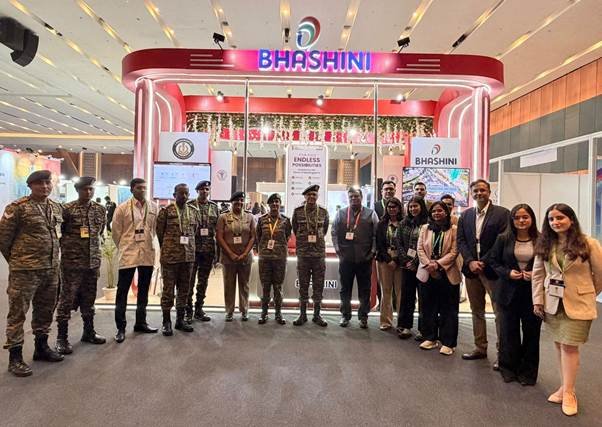
In collaboration with leading healthcare institutions, including the All India Institute of Medical Sciences (AIIMS), JIPMER and the Directorate General of Medical Services (Army), BHASHINI demonstrated how voice-based and multilingual AI solutions can simplify clinical documentation, reduce the workload of healthcare professionals and improve communication between doctors and patients.
Under the summit theme, “Implementing Artificial Intelligence – AI in Action”, the exhibition highlighted practical applications of language technologies in healthcare, particularly in a country where patients and medical professionals communicate in different languages.
Multilingual AI to Make Healthcare More Accessible
BHASHINI presented its multilingual AI ecosystem through an exhibition featuring live demonstrations of its speech-to-text, text-to-speech, translation and other language technology capabilities.
The demonstrations focused on how voice-enabled technologies can support healthcare professionals in documenting clinical information, communicating with patients and accessing healthcare information across Indian languages.
The participation of AIIMS, JIPMER and the Directorate General of Medical Services (Army) showcased the integration of indigenous language technologies into existing healthcare systems.
JIPMER Integrates e-BHASHINI with e-Sushrut HMIS
At Jawaharlal Institute of Postgraduate Medical Education and Research (JIPMER), e-BHASHINI has been integrated with the e-Sushrut Hospital Management Information System (HMIS).
The integration enables doctors to use voice-based documentation for:
-
Recording clinical histories of outpatients.
-
Preparing inpatient department (IPD) notes.
-
Documenting case histories during OPD consultations and IPD rounds.
-
Preparing discharge instructions.
Doctors can dictate clinical information in English or supported Indian languages, reducing the documentation burden and helping healthcare professionals focus more on patient care.
Dr. Anand A, Deputy Officer-in-Charge of the IT Wing and DMS at JIPMER, stated that the initiative uses artificial intelligence and India’s multilingual digital capabilities to make clinical workflows more efficient.
He emphasised that language should never become a barrier to quality healthcare and that indigenous digital technologies can help create a more inclusive, accessible and patient-centred public healthcare system.
AIIMS Uses BHASHINI Speech-to-Text for Prescriptions
At AIIMS New Delhi, BHASHINI’s speech-to-text technology has been integrated with the National Informatics Centre’s (NIC) eHospital prescription module.
The facility enables doctors to dictate prescriptions instead of manually typing them, helping save time during busy outpatient department (OPD) consultations.
According to Prof. Dr. Vivek Tandon, Professor-in-Charge of the Computer Facility at AIIMS, the technology has received positive feedback from doctors during its pilot implementation in the Neurology and Neurosurgery departments.
Building on the pilot experience, the application is now being rolled out across the institute.
The integration demonstrates how speech recognition technology can support doctors by simplifying prescription documentation and improving efficiency in clinical workflows.
Indian Army Uses BHASHINI in Dhanwantri
The Directorate General of Medical Services (Army) showcased the application of BHASHINI’s speech-to-text capabilities in its Dhanwantri system.
The technology converts doctors’ spoken clinical notes into typed text, supporting voice-based medical documentation.
Maj Gen Sandeep Bhalla, ADGMS (IS, H and PS), explained that the Army’s healthcare system serves a multilingual population comprising serving personnel, retired ex-servicemen and their families from different parts of the country.
He stated that integrating BHASHINI’s speech-to-text technology would help save valuable time for doctors and allow patients to communicate in the language of their choice.
This would enable doctors to better understand patients’ concerns and provide prescriptions and medical advice in languages they can understand.
He also acknowledged BHASHINI’s support and expressed confidence in continued collaboration to improve and fine-tune the technology.
Shrutlekh Demonstrates Real-Time Multilingual Transcription
Another key demonstration at the summit was Shrutlekh, BHASHINI’s speech-to-text capability.
The technology demonstrated real-time multilingual transcription and translation, highlighting how speech and language technologies can facilitate communication across language barriers in healthcare and other sectors.
Such capabilities can be particularly useful in healthcare settings where patients and medical professionals may not share the same language.
BHASHINI Showcases Mobile App, Data Daan and Granthika
The exhibition also featured several applications from BHASHINI’s broader multilingual AI ecosystem.
BHASHINI Mobile Application: The mobile application demonstrated translation and voice-based capabilities designed to support communication across languages.
Data Daan: This initiative highlighted the importance of community-driven language data contributions in strengthening Indian language AI systems.
Granthika: The guided platform enables the collection and digitisation of written and oral language resources, supporting the development of language datasets through community participation.
These initiatives contribute to building a stronger ecosystem for multilingual AI and expanding access to digital services across India’s linguistic diversity.
BHASHINI Records Over 11 Billion AI Inferences
The Digital India BHASHINI Division is building a national ecosystem for AI-powered multilingual digital inclusion under the Digital India Corporation (DIC), Ministry of Electronics and Information Technology.
According to the information shared at the summit, BHASHINI supports:
-
36 Indian text languages
-
23 Indian voice languages
-
35 international languages
-
More than 11 billion inferences recorded across its ecosystem.
-
Approximately 24 million inferences processed daily.
Its technology ecosystem includes translation, speech recognition, speech synthesis, transliteration and other language services.
These capabilities enable government and public-facing digital services to become more accessible to people across different linguistic backgrounds.
BHASHINI Aims to Make Language a Bridge, Not a Barrier
Shri Amitabh Nag, CEO of Digital India BHASHINI Division, stated that artificial intelligence can make a meaningful difference in healthcare when designed around the practical needs of healthcare professionals and patients.
He highlighted that BHASHINI’s collaborations with AIIMS, JIPMER and the Directorate General of Medical Services (Army) demonstrate how multilingual AI and voice-enabled technologies can be integrated into clinical workflows, including patient documentation and prescriptions.
He emphasised that language must not become a barrier in the delivery of essential services and that India’s indigenous language technology ecosystem has the potential to make healthcare more efficient, accessible and inclusive.
Global Digital Health Summit 2026
The Global Digital Health Summit 2026 was held on November 20–21, 2026, at Bharat Mandapam, New Delhi, under the theme “Implementing Artificial Intelligence – AI in Action”.
The summit brought together stakeholders from government, healthcare, industry and academia to discuss the practical implementation of AI in healthcare.
It featured technology exhibitions, demonstrations, scientific discussions and interactions focused on advancing digital health solutions and their adoption across healthcare systems.
BHASHINI’s participation highlighted the growing role of multilingual AI in India’s digital healthcare transformation, demonstrating how voice-based technologies can reduce documentation workloads, improve doctor-patient communication and make healthcare services more inclusive.