
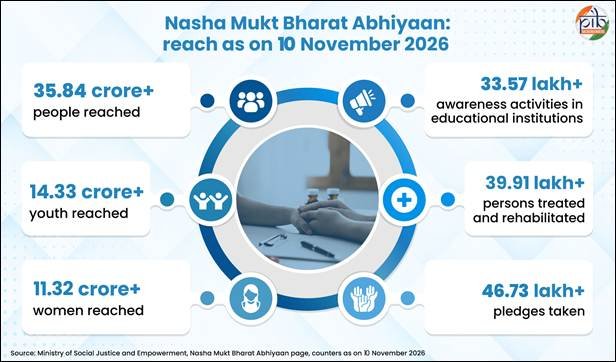
India’s nationwide campaign against substance abuse, the Nasha Mukt Bharat Abhiyaan (NMBA), has completed six years, emerging as one of the country’s largest community-driven initiatives for drug demand reduction. Launched on 15 August 2020 in 272 vulnerable districts, the campaign has now expanded to every district across India, reaching more than 35.84 crore people, including 14.33 crore youth and 11.32 crore women, as of 10 November 2026.
Implemented by the Ministry of Social Justice and Empowerment, the initiative has evolved from an awareness campaign into a nationwide people’s movement, encouraging citizens, educational institutions, government departments, voluntary organisations and community leaders to participate actively in building a drug-free society.
The growing impact of the campaign is also reflected in the increasing number of people accessing treatment and counselling services. The number of individuals seeking assistance at supported facilities increased from 2.08 lakh in 2020-21 to more than 9.11 lakh in 2025-26. Additionally, over 2 lakh citizens have enrolled as Nasha Mukti Mitr, demonstrating increasing public participation in the national effort against substance abuse.
Nasha Mukt Bharat Abhiyaan: From 272 Districts to a Nationwide Movement
The Nasha Mukt Bharat Abhiyaan was launched on 15 August 2020 in 272 districts identified as particularly vulnerable to substance abuse. These districts were selected based on inputs from the Narcotics Control Bureau and findings of the first National Survey on the Extent and Pattern of Substance Use in India.
The campaign was subsequently expanded to 372 districts in August 2022 and extended to all districts of India from 15 August 2023.
The initiative operates as the flagship awareness programme under the National Action Plan for Drug Demand Reduction (NAPDDR), which focuses on prevention, early identification, counselling, treatment and rehabilitation of individuals affected by substance dependence.
Over the six years, the programme has witnessed a significant transformation in its implementation approach. Instead of relying primarily on institutional participation, it increasingly encourages community ownership, local leadership and citizen-led awareness activities.
This transition has helped establish the Abhiyaan as a Jan Andolan (People’s Movement), involving government agencies, educational institutions, NGOs, youth organisations, spiritual institutions and local communities.
Campaign Reaches 35.84 Crore People, Including 14.33 Crore Youth
The scale of public participation reflects the expanding national outreach of the initiative.
As of 10 November 2026, the campaign has achieved the following milestones:
-
35.84 crore people reached through awareness and outreach activities.
-
14.33 crore youth engaged in the campaign.
-
11.32 crore women reached through various initiatives.
-
More than 33.57 lakh awareness activities conducted in educational institutions.
-
Over 2 lakh Nasha Mukti Mitr registered across the country.
-
More than 39.91 lakh persons treated and rehabilitated under supported facilities.
The campaign’s outreach has increased substantially from approximately 1.4 crore people in 2021.
During its fifth anniversary celebrations at Amritsar on 18 November 2025, more than 6 crore people participated in anniversary events organised at over 2.10 lakh locations. By that time, the overall outreach had reached 23.74 crore people.
These achievements highlight the increasing involvement of citizens and institutions in addressing substance abuse as a public health and social development challenge.
Substance Abuse: Understanding the National Challenge
The importance of the campaign becomes evident from the findings of the first National Survey on the Extent and Pattern of Substance Use in India, conducted by the National Drug Dependence Treatment Centre (NDDTC), AIIMS, New Delhi, in 2018 and released in February 2019.
According to the survey:
-
Approximately 16 crore people consumed alcohol, of whom more than 5.7 crore required assistance for harmful or dependent use.
-
Around 3.1 crore people used cannabis products.
-
Approximately 2.26 crore people used opioids.
-
Nearly 25 lakh people were dependent on cannabis.
-
Around 77 lakh people required assistance for opioid use.
-
More than 7 crore individuals were affected by substance use disorders.
-
The affected population included nearly 1.2 crore children and 58 lakh women.
Substance dependence is not merely an individual problem. It can adversely affect families, employment, education, physical health, mental well-being and community relationships.
Recognising the seriousness of the issue, Article 47 of the Constitution of India directs the State to endeavour to prohibit the consumption of intoxicating drinks and drugs injurious to health, except for medicinal purposes.
The Government has been implementing programmes for the prevention of alcoholism and substance abuse since 1985-86.
Three-Tier Monitoring Mechanism to Strengthen Implementation
To improve coordination, accountability and monitoring, a three-tier institutional mechanism has been suggested for drug demand reduction initiatives.
The mechanism operates at the State, District and Block levels, ensuring that preventive activities, treatment facilities and rehabilitation programmes receive regular administrative attention.
1. State and Union Territory-Level Steering and Monitoring Committee
The committee functions under the chairpersonship of the Chief Secretary and is responsible for overall supervision and coordination of the State Action Plan under NAPDDR and NMBA.
Its responsibilities include:
-
Monitoring quarterly and annual targets for awareness, counselling, treatment and rehabilitation.
-
Coordinating the efforts of departments dealing with health, education, social welfare, youth affairs and rural development.
-
Reviewing awareness activities in schools, colleges, villages and vulnerable communities.
-
Monitoring Integrated Rehabilitation Centres for Addicts, District De-addiction Centres and Addiction Treatment Facilities.
-
Identifying vulnerable districts and directing focused intervention programmes.
-
Encouraging partnerships with NGOs, educational institutions and civil society organisations.
2. District-Level Drug Demand Reduction Committee
The District Committee functions under the chairpersonship of the District Collector or Deputy Commissioner.
Its principal responsibilities include preparing district-specific action plans, identifying vulnerable populations, coordinating awareness programmes and strengthening referral mechanisms between educational institutions, communities and healthcare facilities.
The committee also monitors treatment and rehabilitation centres, conducts inspections, reviews beneficiary records and facilitates skill development and livelihood support for recovered individuals.
3. Block-Level Drug Demand Reduction Committee
The Block Committee functions under the chairpersonship of the Block Development Officer.
It focuses on grassroots implementation through:
-
Monitoring awareness activities in villages, schools and colleges.
-
Identifying local areas and populations vulnerable to substance abuse.
-
Conducting monthly inspections of treatment facilities and educational institutions.
-
Engaging Panchayats, teachers, ASHA workers, Anganwadi workers and youth groups.
-
Facilitating referrals for counselling, treatment and rehabilitation.
-
Supporting the social reintegration of recovering individuals.
This three-tier framework is intended to strengthen local accountability and ensure that drug prevention and rehabilitation programmes reach communities requiring assistance.
Financial Support and Budgetary Allocation
The Ministry of Social Justice and Empowerment provides financial assistance to support the implementation of awareness and drug demand reduction activities.
Each district receives ₹10 lakh per financial year as grant-in-aid for campaign activities. Subsequent instalments are released based on utilisation certificates and progress reports.
For the financial year 2026-27, the Union Budget has allocated ₹333 crore for NAPDDR.
The revised estimate for 2025-26 stood at ₹420 crore, compared with an expenditure of ₹268.32 crore during 2024-25.
The funding supports awareness programmes, treatment services, rehabilitation initiatives, capacity building and community participation.
Spiritual Organisations Reach More Than 7.72 Crore People
The Government has also recognised the important role of spiritual and faith-based organisations in spreading awareness against substance abuse.
The Ministry of Social Justice and Empowerment has signed Memoranda of Understanding (MoUs) with several prominent organisations to utilise their community networks for awareness and prevention activities.
These organisations include:
-
Brahma Kumaris
-
The Art of Living
-
Sant Nirankari Mission
-
All World Gayatri Pariwar
-
ISKCON
-
Shri Ram Chandra Mission
-
University of Patanjali
-
Sivananda Yoga Vedanta Dhanwantari Ashram
-
Chinmaya Mission
-
Divya Jyoti Jagrati Sansthan
-
Hare Krishna Movement
-
Bosconet (Don Bosco)
Through community programmes, school sessions, bike rallies, competitions, mobile awareness vans, counselling sessions, awareness runs and meditation activities, these organisations have collectively reached more than 7.72 crore people.
The Ministry is also working towards establishing partnerships with additional organisations to expand the campaign’s reach.
NMBA 2.0 App Introduced for Digital Monitoring and Citizen Participation
Technology has become an important component of the campaign’s implementation and monitoring framework.
The original NMBA mobile application was developed to collect information about campaign activities and provide data through the NMBA Dashboard at district, State and national levels.
The upgraded NMBA 2.0 App was launched on 24 April 2026 during the Chintan Shivir held in Chandigarh.
The application provides several facilities for citizens, including:
-
Taking the Nasha Mukt Bharat e-Pledge.
-
Accessing educational and awareness material.
-
Finding information about de-addiction helplines.
-
Locating the nearest de-addiction centre.
-
Participating in the national awareness campaign.
The digital platform is intended to strengthen transparency, improve monitoring and make information about support services more accessible.
National Helpline 14446 Provides Round-the-Clock Assistance
Access to counselling and timely intervention is essential for individuals and families affected by substance dependence.
The National De-addiction Helpline has been operational since 1 March 2017. Initially available through the number 1800-11-0031, it now operates through the toll-free number 14446.
The helpline provides 24-hour tele-counselling services and facilitates referrals to the nearest supported treatment facility. It has received approximately 5.10 lakh calls to date.
Citizens can also access other national support mechanisms:
-
MANAS Helpline – 1933: Operated by the Narcotics Control Bureau, it enables citizens to report drug-related issues through calls, SMS, chatbot, email and the web.
-
Tele-MANAS: A national tele-mental health programme launched on 10 October 2022 to expand access to mental health counselling and care.
These services complement the broader national framework for prevention, treatment and rehabilitation.
Nasha Mukti Mitr: Encouraging Citizens to Become Community Change Agents
A major feature of the Abhiyaan is the Nasha Mukti Mitr (NMM) initiative, which encourages citizens to voluntarily participate in drug demand reduction activities.
Any citizen can register as a Nasha Mukti Mitr through the official NMBA portal and receive a certificate and NMBA badge based on their level of participation.
The responsibilities of Nasha Mukti Mitr include:
-
Creating awareness about the harmful effects of substance abuse.
-
Encouraging young people to remain away from drugs and addictive substances.
-
Helping affected individuals and families connect with counselling and treatment facilities.
-
Participating in awareness campaigns, rallies and community programmes.
-
Promoting the national helpline and the Nasha Mukt Bharat pledge.
-
Supporting individuals undergoing recovery and rehabilitation.
As of 10 November 2026, more than 2 lakh citizens had registered as Nasha Mukti Mitr.
A Personal Dashboard, launched on 17 June 2026, enables registered volunteers to track their activities, access information and educational material, and take the NMBA e-pledge.
The Nasha Mukt Bharat Saptah, organised from 17 to 26 June 2026 under the theme “Nasha Mukt Bharat Abhiyaan, Viksit Bharat Ki Pehchaan”, attracted 1.31 crore participants through pledge drives, rallies, competitions, street plays and yoga sessions.
The campaign had also recorded more than 46.73 lakh pledges as of 10 November 2026.
Treatment and Rehabilitation Network Expands Across India
Beyond awareness generation, the Government is strengthening the availability of professional treatment and rehabilitation services through five categories of facilities supported under NAPDDR.
National Treatment Infrastructure
| Type of facility | Number |
|---|---|
| Integrated Rehabilitation Centres for Addicts (IRCAs) | 344 |
| Outreach and Drop-In Centres (ODICs) | 71 |
| Community-based Peer-Led Intervention Centres (CPLIs) | 45 |
| District De-addiction Centres (DDACs) | 198 |
| Addiction Treatment Facilities (ATFs) | 155 |
These facilities perform different but complementary functions.
Integrated Rehabilitation Centres for Addicts (IRCAs) provide inpatient treatment, counselling and rehabilitation services.
Outreach and Drop-In Centres (ODICs) focus on screening, assessment, counselling and referral of individuals requiring treatment.
Community-based Peer-Led Intervention Centres (CPLIs) involve youth volunteers in early prevention activities, particularly among vulnerable adolescents.
District De-addiction Centres (DDACs) bring together the services of IRCAs, ODICs and CPLIs under one roof at district headquarters.
Addiction Treatment Facilities (ATFs) are established in Government hospitals to provide treatment services, with technical involvement from NDDTC, AIIMS and other designated institutions.
The Ministry’s records show that 39.91 lakh persons had been treated and rehabilitated as of 10 November 2026.
The increase in people seeking assistance from 2.08 lakh in 2020-21 to more than 9.11 lakh in 2025-26 indicates the growing reach of the treatment and counselling network.
Rehabilitation and Reintegration: A Recovery Story from AIIMS Guwahati
The importance of comprehensive treatment and family support is reflected in a recovery case highlighted by the Ministry.
A 31-year-old graduate from Assam, identified as Amit (name changed), was admitted to the emergency department of AIIMS Guwahati following a heroin overdose.
He received opioid substitution therapy, treatment for Hepatitis C and relapse prevention therapy. His family also played an important role in supporting his recovery.
Following discharge, the hospital’s Addiction Treatment Facility continued his care and monitoring.
Within two to three months, Amit found employment and has remained free from substance use for more than a year. His medication is now being reduced under medical supervision.
The case demonstrates the importance of timely medical intervention, family support, continued treatment and livelihood opportunities in helping individuals rebuild their lives.
Jammu and Kashmir’s Anti-Drug Campaign: A Model for Other States
Jammu and Kashmir has emerged as an important example of coordinated implementation of drug prevention and rehabilitation programmes.
As of 2 November 2026, the campaign had reached more than 1.26 crore people in the Union Territory, including 72.26 lakh youth and 54.04 lakh women.
Additionally, 11,152 Nasha Mukti Mitr had joined the initiative.
The Ministry supports the following facilities in Jammu and Kashmir:
-
One Integrated Rehabilitation Centre for Addicts.
-
Three Outreach and Drop-In Centres.
-
Two Community-based Peer-Led Intervention Centres.
-
Six District De-addiction Centres.
-
Twenty-one Addiction Treatment Facilities.
The national helpline has also received more than 11,000 calls from the Union Territory.
Under the Nasha Mukt J&K 100 Days Abhiyaan, Addiction Treatment Facilities attended to more than 66,500 outpatients.
Government Medical College, Srinagar, has also presented a Circle of Care model that follows individuals from admission and treatment to rehabilitation, reintegration and long-term monitoring.
A proposed Rehabilitation and Socio-Economic Reintegration Scheme for Drug Abuse Victims, 2026, envisages a three-year recovery framework.
Second National Survey to Provide District-Level Estimates
The Government is preparing to strengthen its evidence-based approach through the second National Survey on the Extent and Pattern of Substance Use in India.
The first national survey covered approximately 2 lakh households across 186 districts in all 36 States and Union Territories. More than 4.73 lakh individuals between 10 and 75 years of age were interviewed.
An additional respondent-driven sampling exercise covered more than 70,000 people dependent on illicit drugs across 123 districts.
The second survey, entrusted to NDDTC, is expected to provide district-level estimates for the first time, with its results anticipated in 2027.
The findings are expected to help authorities identify vulnerable areas, understand changing patterns of substance use and design targeted prevention and treatment programmes.
Road Ahead: Strengthening India’s Commitment to a Drug-Free Society
The Ministry is restructuring NAPDDR following consultations with State Governments, Union Territories, NGOs, experts, grant-in-aid institutions and other stakeholders.
The proposed improvements focus on strengthening prevention, treatment, rehabilitation, telemedicine and coordination among departments.
At the third National Conference of the heads of Anti-Narcotics Task Forces of States and Union Territories in September 2026, the Union Home Minister outlined the national resolve to collectively uproot the drug trade by 31 December 2029.
The broader objective is to protect young people, strengthen communities and support the vision of Viksit Bharat 2047.
After six years, the Nasha Mukt Bharat Abhiyaan has expanded from 272 districts to a nationwide movement involving more than 35.84 crore people. Its growing network of volunteers, treatment centres, educational institutions and community organisations reflects a comprehensive approach to tackling substance abuse.
The next phase will depend on stronger grassroots participation, early identification, accessible professional treatment, rehabilitation and the social reintegration of recovered individuals.
Ultimately, the success of a drug-free India will require sustained cooperation between the Government, families, educational institutions, healthcare professionals and citizens.
The National De-addiction Helpline 14446 remains available round the clock for individuals and families seeking assistance.
Important Government Links
-
NMBA e-Pledge: https://nashamukt.dosje.gov.in/epledge
-
Register as Nasha Mukti Mitr: https://nashamukt.dosje.gov.in/nasha-mukti-mitr
Source: PIB