
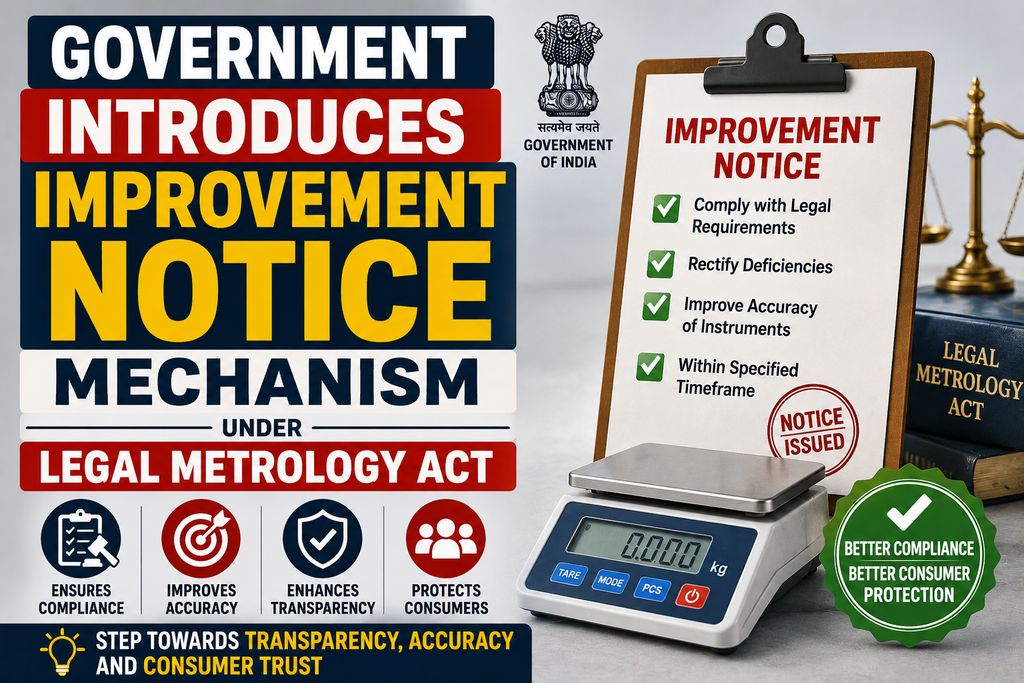
The Government of India has introduced a significant reform under the Legal Metrology Act, 2009 by implementing the Improvement Notice mechanism through the Jan Vishwas (Amendment of Provisions) Act, 2026. The initiative aims to create a more transparent, trust-based, and business-friendly regulatory environment while maintaining robust consumer protection.
The new mechanism allows businesses committing specified first-time procedural or regulatory non-compliances to rectify their mistakes before any penal action is initiated. This reform is expected to reduce unnecessary litigation, lower compliance costs, and encourage voluntary compliance among businesses across India.
What is the Improvement Notice Mechanism?
The Improvement Notice is a facilitative compliance tool under the Legal Metrology Act. If a manufacturer, importer, dealer, trader, repairer, or any other regulated entity commits a specified first-time procedural or regulatory violation, the Legal Metrology Officer may issue an Improvement Notice instead of immediately initiating penal proceedings.
The notice identifies the deficiency and provides a reasonable period for the business to rectify the issue.
If the business successfully complies within the stipulated period, it can avoid penalties and legal proceedings. However, failure to comply or repeated violations will continue to attract action under the provisions of the Legal Metrology Act.
This reform marks a shift from punitive regulation towards a more collaborative compliance framework that supports honest businesses without compromising enforcement.
Objective of the Reform
The Government has introduced this mechanism to strengthen Ease of Doing Business (EoDB) by reducing regulatory burdens while ensuring consumer interests remain protected.
The primary objectives include:
- Encouraging voluntary compliance among businesses.
- Providing an opportunity to correct genuine first-time mistakes.
- Reducing unnecessary litigation arising from procedural lapses.
- Lowering compliance costs for businesses and MSMEs.
- Creating a predictable and transparent regulatory system.
- Allowing enforcement agencies to focus on serious violations and fraud.
The reform aligns with the Government’s vision of “Minimum Government, Maximum Governance.”
Who Will Benefit?
The Improvement Notice mechanism applies to a wide range of regulated entities, including:
- Manufacturers
- Importers
- Packers
- Dealers
- Repairers
- Traders
- MSMEs
- Other businesses regulated under the Legal Metrology Act
This provides relief to genuine businesses that may inadvertently commit procedural errors while carrying out their operations.
Key Features of the Improvement Notice Mechanism
Some of the major highlights include:
Opportunity Before Penalty
Businesses committing specified first-time procedural violations receive an opportunity to rectify deficiencies before any penal proceedings begin.
Promotes Voluntary Compliance
Instead of immediately imposing penalties, the mechanism encourages businesses to comply voluntarily with legal requirements.
Reduces Litigation
By allowing businesses to rectify genuine mistakes, the reform is expected to significantly reduce avoidable legal disputes and administrative burden.
Maintains Strong Consumer Protection
The Government has clarified that the mechanism does not weaken enforcement or dilute consumer protection provisions.
Serious offences such as:
- Fraud
- Repeated violations
- Tampering
- Deliberate misuse
- Consumer deception
will continue to attract strict legal action.
Provisions Covered Under the Improvement Notice
The mechanism applies to specified first-time procedural and regulatory non-compliances relating to:
- Registration requirements
- Documentation and record maintenance
- Model approval
- Manufacture and sale of weights and measures
- Repair of weights and measures
- Import of weights and measures
- Packaged commodities
- Statutory returns and information
It covers the following provisions of the Legal Metrology Act, 2009:
- Section 25 – Use of non-standard weights or measures
- Section 27 – Manufacture or sale of non-standard weights or measures
- Section 28 – Transactions contrary to prescribed standards
- Section 29 – Publishing non-standard units
- Section 31 – Non-production of documents
- Section 32 – Failure to obtain model approval
- Section 34 – Sale using non-standard weights or measures
- Section 35 – Services rendered using non-standard weights or numbers
- Section 36(1) – Sale of non-standard packaged commodities
- Section 38 – Import without registration
- Section 39 – Import of non-standard weights and measures
- Section 41(1) & 41(2) – Furnishing false information or returns
- Section 45 – Manufacturing without registration
- Section 46 – Repair or sale without registration
- Section 47 – Tampering with Registration Certificate
Balancing Ease of Business with Consumer Protection
The Department of Consumer Affairs has emphasized that the Improvement Notice mechanism applies only to specified first-time procedural and regulatory non-compliances.
Deliberate violations that compromise consumer rights will continue to face strict enforcement.
This balanced approach supports genuine businesses while preserving the integrity of India’s legal metrology system.
How the Reform Supports Businesses
The new framework is expected to provide several long-term benefits:
- Reduced compliance burden
- Lower legal costs
- Greater regulatory certainty
- Improved trust between businesses and regulators
- Faster correction of procedural errors
- Enhanced ease of doing business
- Better investment climate
MSMEs and small businesses, in particular, are likely to benefit from this facilitative approach, enabling them to focus more on growth rather than compliance-related litigation.
Conclusion
The introduction of the Improvement Notice mechanism under the Legal Metrology Act represents a landmark regulatory reform aimed at modernising India’s compliance framework. By allowing businesses to rectify genuine first-time procedural lapses before penal action, the Government has taken a significant step towards building a trust-based regulatory ecosystem.
While simplifying compliance for honest businesses, the reform continues to maintain strict enforcement against fraud, repeated violations, and practices that harm consumer interests. As India continues its journey towards improving the Ease of Doing Business, this balanced approach strengthens both business confidence and consumer protection.