
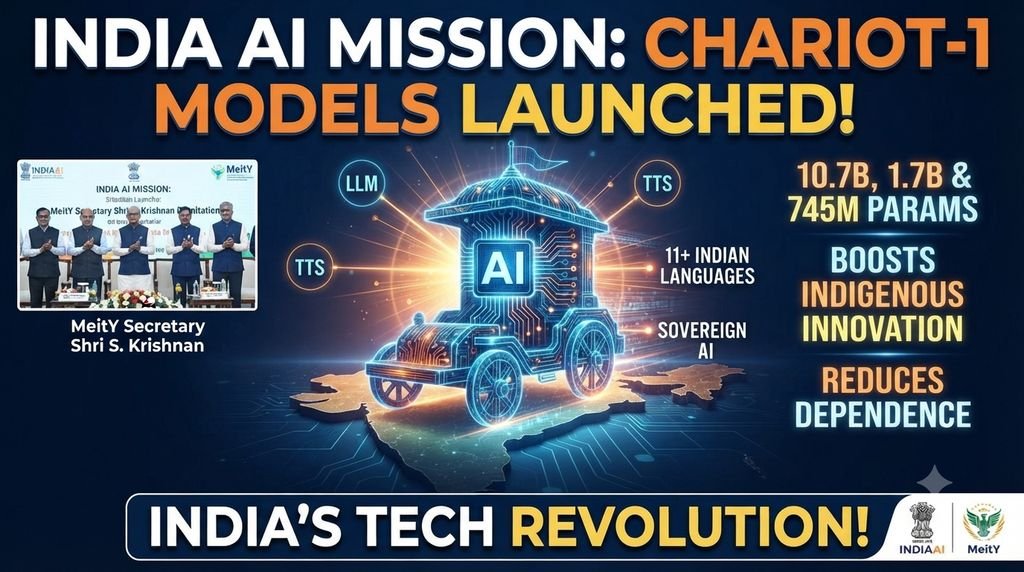
India has taken another significant step towards strengthening its indigenous Artificial Intelligence (AI) ecosystem with the launch of Chariot-1 Foundation Models, developed by Chariot Artificial Intelligence Pvt. Ltd. under the Government of India’s IndiaAI Mission. The models aim to advance multilingual language processing, speech generation and computational efficiency through research and technology developed entirely in India.
The models were inaugurated by Shri S. Krishnan, Secretary, Ministry of Electronics and Information Technology (MeitY), at Bharat Mandapam, New Delhi. The launch and research showcase highlighted India’s growing capabilities in developing sovereign AI technologies tailored to its linguistic diversity and technological requirements.
Chariot Artificial Intelligence Pvt. Ltd. is among the first four teams selected under the IndiaAI Mission to develop sovereign foundation models. The initiative reflects the government’s commitment to promoting homegrown AI research, technological innovation and self-reliance in advanced computing.
Chariot-1: A New Generation of Indigenous Foundation Models
The Chariot-1 model suite comprises two key technologies:
-
Chariot-1 Large Language Model (LLM): Designed for advanced language understanding and processing.
-
Chariot-1 Text-to-Speech (TTS): Developed to generate natural-sounding speech in English and multiple Indian languages.
Both models have been pre-trained from scratch in India, incorporating original research innovations to improve computational efficiency, multilingual capabilities and adaptability across different hardware environments.
The models are designed to address the challenges of India’s diverse linguistic landscape while making advanced AI technologies more accessible.
Three Research Innovations Driving Chariot-1
The Chariot team introduced three significant research innovations integrated into the training of Chariot-1. These developments aim to improve how AI models process Indian languages, utilise computing resources and handle large vocabularies.
1. IndicShift: Improving AI Understanding of Indian Languages
IndicShift is an open-source innovation that introduces a shared alphabet for Indian scripts. Instead of treating every Indian script independently, the approach enables AI models to utilise similarities across different languages.
Key features include:
-
Covers 1,012 characters across 12 Indian scripts through 350 letters.
-
Achieves up to 2.5 times fewer tokens on Indian-language text compared with OpenAI’s GPT tokeniser.
-
Reports a 5% to 8% improvement in Indian-language model performance using the same computing resources.
-
Maintains performance in English and programming code.
This innovation could significantly improve the efficiency of AI systems working with India’s multilingual population.
2. Nested Training: Training Multiple Model Sizes Together
Nested Training introduces an approach that enables three complete model sizes to be trained simultaneously through a single training run using one set of weights.
Traditionally, separate models need to be trained for different computing environments. Nested Training addresses this challenge by enabling models to be deployed across:
-
Large data centres
-
Personal computers and laptops
-
Smartphones
-
Edge computing devices
The research reports a 62% improvement in training speed compared with training three model sizes separately.
This approach could make advanced AI deployment more economical and accessible across different hardware configurations.
3. Mixture of Vocabularies: Improving Training Efficiency
The third innovation, Mixture of Vocabularies, optimises the process through which an AI model selects and evaluates words.
It divides the model’s vocabulary into 11 groups, allowing the system to score only the relevant group rather than evaluating the entire vocabulary for every word.
The reported benefits include:
-
5.7 times reduction in vocabulary entries scored per word.
-
38% improvement in training speed using the same GPUs.
-
Negligible change in model loss.
This innovation contributes to reducing computational requirements while maintaining model performance.
Chariot-1 LLM: 11 Billion Parameters with Three Model Sizes
The Chariot-1 Large Language Model is an 11-billion-parameter Mixture-of-Experts (MoE) model, with approximately 4 billion active parameters per token.
The model has been pre-trained from scratch in India and is available in three sizes to support different computing requirements.
| Model version | Parameters |
|---|---|
| Chariot-1 Large | 10.7 billion |
| Chariot-1 Medium | 1.7 billion |
| Chariot-1 Small | 745 million |
The availability of multiple model sizes enables deployment across different environments, from powerful data centres to devices with limited computing capacity.
The approach also supports wider adoption of indigenous AI technologies by organisations with varying infrastructure capabilities.
Chariot-1 Text-to-Speech Supports English and 10 Indian Languages
A major component of the Chariot-1 suite is its Text-to-Speech (TTS) model, designed to generate speech in English and 10 Indian languages.
The supported Indian languages are:
-
Hindi
-
Bengali
-
Marathi
-
Tamil
-
Telugu
-
Kannada
-
Malayalam
-
Gujarati
-
Punjabi
-
Odia
One of the distinctive features of the speech model is its ability to understand context and determine how different types of information should be spoken.
It can appropriately verbalise:
-
Numbers and dates
-
Currencies and monetary values
-
Measurement units
-
Website URLs
-
Abbreviations
-
Other non-standard text formats
This capability helps generate more natural and context-aware speech, addressing an important challenge in developing practical speech technologies for Indian languages.
Chariot-1 TTS Records More Than 97% Verbalisation Accuracy
The speech model demonstrated promising results in the Async TTS Pronunciation Benchmark.
The benchmark comprised 1,029 real-world sentences containing 2,251 instances of non-standard text across 42 categories.
The reported results include:
-
Over 97% verbalisation accuracy on the benchmark.
-
7.60% Hindi Character Error Rate (CER).
-
6.47% average Character Error Rate across nine other Indian languages.
According to the reported evaluation, the model achieved the lowest character error rates among the systems assessed in the tests.
These results highlight the importance of developing speech technologies that understand the specific pronunciation, structure and contextual requirements of Indian languages.
MeitY Secretary Highlights India’s Growing AI Capabilities
Speaking at the launch, Shri S. Krishnan, Secretary, MeitY, congratulated the Chariot team and described the launch of Chariot One as a significant achievement for India’s technology ecosystem.
He appreciated the team’s innovative approach, particularly its efficient representation of Indian languages and contribution towards advancing indigenous AI capabilities.
He emphasised that the IndiaAI Mission was established to identify, nurture and support talented innovators working on advanced AI technologies.
He also acknowledged the contribution of two Stanford graduates who returned to India to develop advanced AI technology, describing their efforts as an example of the potential of India’s young innovators.
The launch demonstrated India’s growing ability to develop cutting-edge technologies through domestic research and innovation.
Industry Leaders Discuss Emerging AI Developments
The event also featured a fireside conversation between Shri Vishal Dhupar, Managing Director, South Asia, NVIDIA, and Shri Suvrat Bhooshan, Co-Founder, Chariot Artificial Intelligence, focusing on emerging developments in AI research and the rapidly evolving technology landscape.
The discussion highlighted the importance of research, innovation and collaboration in building India’s position in the global AI ecosystem.
IndiaAI Mission: Strengthening India’s Sovereign AI Ecosystem
The launch of Chariot-1 represents an important development in India’s efforts to establish a strong domestic foundation model ecosystem.
Through the IndiaAI Mission, the Government of India is supporting researchers, startups and technology enterprises working towards the development of indigenous AI technologies.
The initiative seeks to:
-
Encourage the development of sovereign foundation models.
-
Strengthen domestic technological capabilities.
-
Reduce dependence on externally developed AI technologies.
-
Support multilingual AI applications.
-
Build an inclusive and globally competitive AI ecosystem.
The development of Chariot-1 demonstrates how homegrown research can address India’s specific technological and linguistic requirements.
With innovations in multilingual language processing, speech generation and efficient model training, Chariot-1 adds to India’s growing portfolio of indigenous AI technologies and strengthens the country’s ambition to become a significant contributor to the global artificial intelligence landscape.
Conclusion
The launch of Chariot-1 Foundation Models marks another milestone in India’s journey towards technological self-reliance. By combining indigenous research with innovations in language processing, model training and speech generation, the project addresses challenges that are particularly relevant to India’s multilingual society.
Supported by the IndiaAI Mission, such initiatives can help create an AI ecosystem that is not only technologically advanced but also accessible, inclusive and responsive to India’s diverse linguistic communities.