
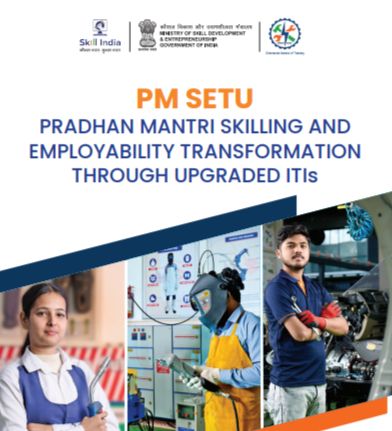
The Union Cabinet has approved the Pradhan Mantri Skilling and Employability Transformation through Upgraded ITIs (PM-SETU) scheme with the aim of transforming India’s vocational education ecosystem. The scheme focuses on upgrading Industrial Training Institutes (ITIs) and National Skill Training Institutes (NSTIs) to make vocational training more relevant, industry-aligned, and outcome-oriented. PM-SETU is a key reform initiative to improve employability, strengthen industry linkage, and prepare India’s workforce for emerging sectors.
Key Objectives of PM-SETU Scheme
The PM-SETU scheme has been designed with the following core objectives:
Improve Quality of Training Delivery
To enhance the overall quality of vocational training imparted in ITIs and NSTIs, ensuring better learning outcomes and job readiness.
Modernise Infrastructure and Equipment
To upgrade training infrastructure with modern labs, smart classrooms, advanced machinery, and digital learning tools, aligned with current and future industry standards.
Introduce Industry-Aligned Courses
To roll out long-term and short-term courses that match industry demand, especially in new and emerging sectors, thereby improving relevance and employability.
Strengthen Industry Linkages
To promote demand-driven skilling through strong partnerships with industry, leading to better placements, apprenticeships, and real-world exposure for trainees.
Enhance Capacity of NSTIs
To strengthen National Skill Training Institutes for advanced training of trainers (ToT), ensuring high-quality instructors capable of delivering modern vocational education.
Components of the PM-SETU Scheme
Component I – Upgradation of Government ITIs
Under this component, 1,000 Government ITIs will be upgraded using a Hub and Spoke model, comprising 200 Hub ITIs and 800 Spoke ITIs. The upgradation includes modern infrastructure, digital content, new industry-aligned courses, and improved training delivery systems.
Component II – Capacity Augmentation of NSTIs
Five NSTIs located in Bhubaneswar, Chennai, Hyderabad, Kanpur, and Ludhiana will be strengthened through capacity augmentation. This includes the establishment of sector-specific National Centres of Excellence, with a strong focus on advanced trainer development and global partnerships.
Governance and Implementation Framework
PM-SETU follows an industry-led governance model. The selection of ITIs is led by State and UT Governments in consultation with industry partners to ensure alignment with local industrial potential and emerging skill needs.
At the national level, a National Steering Committee (NSC) chaired by the Secretary, MSDE, provides policy direction, finalises operational guidelines, and monitors implementation. At the State/UT level, State Steering Committees (SSCs) chaired by Chief Secretaries oversee execution. So far, 25 States/UTs have constituted SSCs, and 10 States/UTs have initiated industry engagement through proposals.
PM-SETU and Employability Outcomes
PM-SETU is primarily a vocational education and training upgradation scheme, not a startup-specific programme. However, by improving training quality and industry exposure, it indirectly supports self-employment and entrepreneurship, including first-time entrepreneurs and early-stage enterprises, through skill development, career guidance, placement support, and exposure to real work environments.
State-Level Pilot Implementation
In Maharashtra, three clusters have been identified in Pune, Nagpur, and Chhatrapati Sambhajinagar districts during the pilot phase. No proposal has been received from Palghar district at this stage.
In Bihar, two clusters in Patna and Darbhanga districts have been identified, and the State is set to issue a Request for Proposal (RFP) to invite industry participation.
Conclusion
The PM-SETU scheme marks a significant step towards strengthening India’s ITI and NSTI ecosystem through modern infrastructure, industry-aligned training, and improved governance. By focusing on employability, trainer capacity, and industry relevance, PM-SETU aims to build a skilled, adaptable, and future-ready workforce aligned with India’s economic and industrial growth goals.