
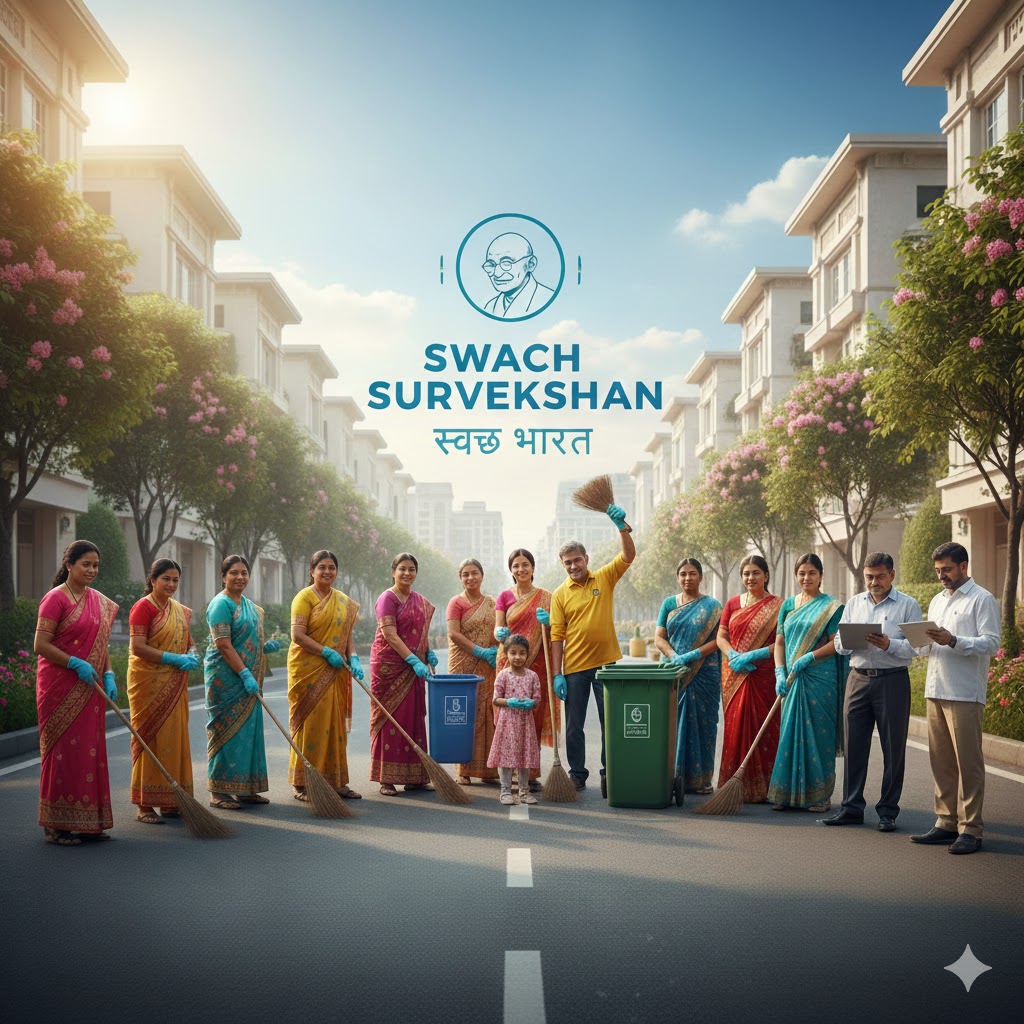
The Ministry of Housing and Urban Affairs (MoHUA) has officially launched the 10th edition of Swachh Survekshan (SS 2025–26), the world’s largest urban cleanliness survey, marking a significant milestone of ten years of citizen-led sanitation reform in India. The toolkit for the new edition was released by Union Minister Shri Manohar Lal, Minister for Housing and Urban Affairs, at Bhopal, Madhya Pradesh, with participation from States and Urban Local Bodies (ULBs) across the country through virtual mode.
Swachh Survekshan has evolved from a simple ranking exercise into a powerful management and governance tool, catalysing visible and measurable improvements in urban sanitation and waste management, while reinforcing the national ethos of Swabhav Swachhata, Sanskaar Swachhata.
A Decade of Swachh Survekshan: From Assessment to Transformation
Over the last ten years, Swachh Survekshan has played a defining role in shaping India’s urban cleanliness landscape. From assessing 73 Urban Local Bodies (ULBs) in 2016 to evaluating over 4,900 ULBs in 2024, the survey has consistently raised benchmarks, encouraged healthy competition, and guided cities on the roadmap to becoming Swachh Shehar and Garbage Free Cities (GFCs).
By defining clear performance matrices, on-ground parameters and service delivery standards, SS has enabled cities to institutionalise sanitation reforms and improve quality of life for millions of urban residents.
Citizen Voice Strengthened with Round-the-Year Feedback
A defining feature of Swachh Survekshan 2025–26 is the significant enhancement of citizen participation. Recognising citizens as equal stakeholders in urban cleanliness, the new toolkit gives greater weightage to citizen validation and perception.
From this year onwards, citizens can provide feedback round the year using multiple digital platforms such as the Vote For My City App and Portal, MyGov App, Swachhata App, and QR code-based interfaces. This continuous engagement model ensures that citizen opinion is not limited to a short survey window but becomes a sustained driver of accountability and service improvement.
Expanded Scope: River Towns and Coastal Cities Included
Building on earlier assessments of Ganga towns, Swachh Survekshan 2025–26 expands its ambit to include river towns across the country, reflecting a stronger focus on waterbody cleanliness and environmental sustainability. Additionally, a separate assessment matrix for coastal cities has been introduced, recognising the unique sanitation and waste management challenges of coastal regions.
This expansion aligns Swachh Survekshan more closely with integrated urban environmental management goals.
New Award Categories and Swachh Shehar Jodi Mentorship Framework
To promote structured peer learning, MoHUA has introduced new award categories under Swachh Survekshan 2025–26, especially linked to the Swachh Shehar Jodi (SSJ) mentorship initiative launched under Swachh Bharat Mission–Urban (SBM-U) in September 2025.
Under this programme, 72 mentor cities and 200 mentee cities have signed MoUs to facilitate knowledge sharing, replication of best practices and capacity building in urban waste management. Cities will now be recognised based on the average performance score of Swachh Shehar Jodis, with awards across different population categories.
Robust, Transparent and Technology-Driven Assessment Framework
The 10th Swachh Survekshan introduces a tightly monitored, protocol-driven assessment mechanism to ensure quality and credibility. A national oversight team will anchor the process, supported for the first time by a dedicated single-point-of-contact in-charge for each State and Union Territory.
More than 3,000 trained field assessors will conduct a 45-day on-ground survey covering all ULBs, backed by GPS-enabled real-time monitoring. The entire process—from evidence submission to verification—is fully digital, transparent and rigorously quality-checked, reinforcing trust in the rankings.
Assessment Timeline and Certification Process
Following the toolkit release, field assessments are expected to commence between mid-February and March 2026. Simultaneously, Garbage Free City (GFC) and Open Defecation Free (ODF) certification assessments will begin from mid-February 2026.
Swachh Survekshan: A Jan Andolan at the Heart of SBM-U
Swachh Bharat Mission–Urban stands as a global example of a people’s movement, and Swachh Survekshan lies at its core. Over the years, it has transformed into a platform that empowers citizens, fosters ownership, strengthens grievance redressal systems, and instils pride in urban governance.
As cities intensify their efforts to become cleaner and more liveable, Swachh Survekshan 2025–26 continues to reinforce cleanliness as a shared national aspiration, driven by partnership between governments, urban institutions and citizens.