

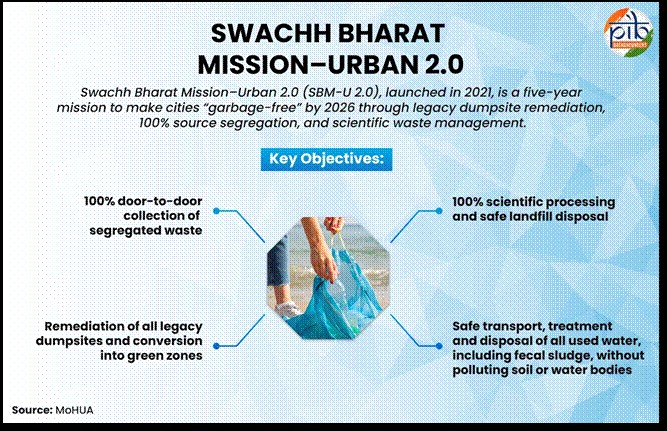
India aims to achieve “Zero Dumpsites” by October 2026 through the Dumpsite Remediation Accelerator Programme (DRAP) launched under Swachh Bharat Mission–Urban 2.0.
Over 61% of India’s legacy waste has already been processed, with 214 high-impact dumpsites prioritised as they account for nearly 80% of the remaining waste.
Legacy waste is converted into usable resources such as road construction material, recyclables, Refuse-Derived Fuel (RDF), and filling material for low-lying areas.
Remediation delivers multiple benefits, including cleaner air, safer groundwater, reduced fire hazards, methane emission control, and reclaimed land for green cover and urban infrastructure.
Introduction: From Clean Cities to Zero Dumpsites
India’s urban cleanliness journey has made steady progress over the past decade under the Swachh Bharat Mission (SBM). Improved sanitation infrastructure, universal waste collection, and heightened public awareness have transformed urban environments. Building on this foundation, the focus has now shifted to eliminating legacy waste dumpsites, which represent one of the biggest environmental challenges in Indian cities.
To fast-track this transition, the Government of India launched the Dumpsite Remediation Accelerator Programme (DRAP) in November 2025, with a clear national goal of “Lakshya: Zero Dumpsites” by October 2026. This marks the next phase of India’s urban cleanliness and sustainability efforts.
Legacy Dumpsites: Scale of the Challenge
A dumpsite refers to land used by Urban Local Bodies for disposing municipal solid waste, often through unscientific methods over decades. Such sites contaminate soil and groundwater, degrade air quality, emit methane, and pose serious fire and public health risks.
Across India, 2,479 dumpsites containing more than 1,000 tonnes of waste have been identified. Together, they hold nearly 25 crore metric tonnes of legacy waste, spread over 15,000 acres. With cities generating around 1.62 lakh tonnes of waste daily, the urgency for scientific remediation has never been greater.
Currently, remediation is underway at 1,428 dumpsites, with over 62% of legacy waste already processed. Under DRAP, 214 high-impact dumpsites across 30 States and UTs have been prioritised for accelerated action.
Mission Strategy: Preventing Old and New Dumpsites
The approach follows a double-pronged strategy—remediating old dumpsites while ensuring no new dumpsites are created. All reclaimed land is prioritised for Solid Waste Management (SWM) infrastructure or green development, reinforcing sustainable urban planning.
In 2025 alone, 459 dumpsites across 438 cities achieved complete remediation, adding to a cumulative total of 1,138 fully remediated dumpsites nationwide.
The 5P Framework Driving DRAP
DRAP is anchored in the 5P Framework of SBM–Urban 2.0:
Political Leadership ensures high-level oversight and faster decision-making.
Public Finance provides financial assistance, including ₹550 per tonne of legacy waste and project funding worth over ₹6,700 crore.
Partnerships enable collaboration with PSUs, industries, highways authorities, cement plants, and NGOs.
People’s Participation engages communities through awareness drives, health camps, and improved safety for Safai Mitras.
Project Management leverages technology for monitoring, accountability, and timely execution.
From Dumpsite to Resource: Circular Economy in Action
Legacy waste is processed through biomining, a scientific method that stabilises and segregates waste into reusable fractions. Inert material supports road construction and embankments, RDF replaces coal in industries, recyclables are reprocessed, biodegradable waste is composted, and only non-reusable rejects go to scientific landfills. This circular approach ensures permanent elimination of dumpsites.
Strengthening Urban Waste Processing Ecosystem
Under SBM–Urban 2.0, India is expanding Material Recovery Facilities (MRFs), composting plants, biomethanation units, compressed biogas plants, and waste-to-electricity facilities, creating a robust waste-processing ecosystem across cities.
Way Forward: Cleaner Cities, Healthier Communities
Achieving Zero Dumpsites by 2026 will significantly improve public health, reduce greenhouse gas emissions, reclaim valuable urban land, and integrate sanitation workers into formal systems. This mission supports SDG 11, SDG 12, and SDG 13, while advancing the vision of Viksit Bharat 2047—where urban growth aligns with sustainability, resilience, and quality of life.