

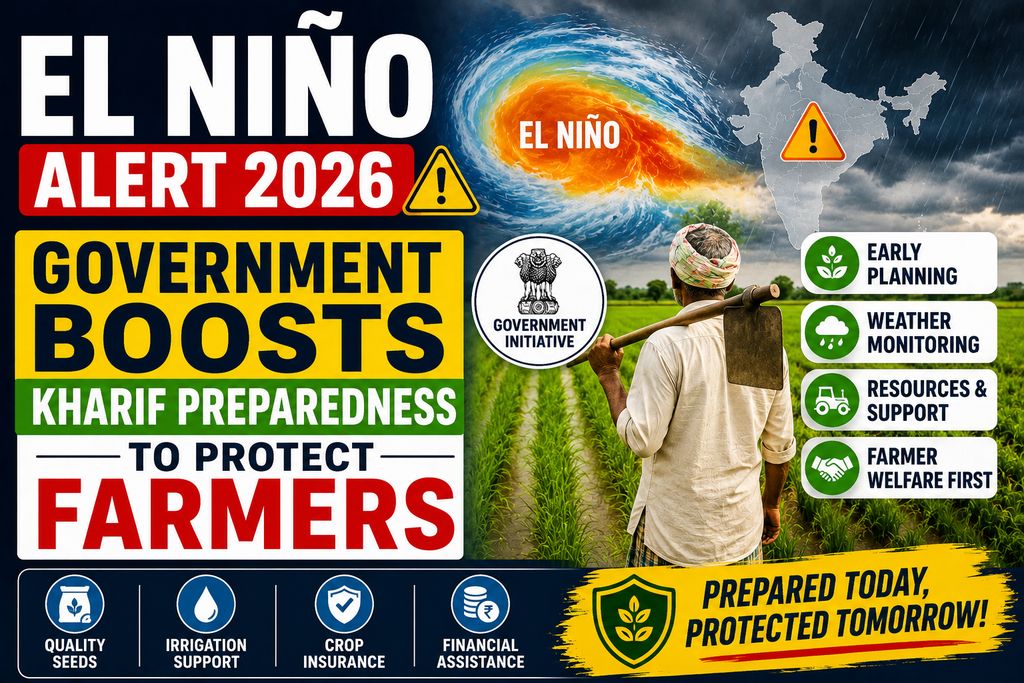
The Central Government has stepped up its preparations for the upcoming Kharif 2026 season amid concerns over the possible development of El Niño conditions and below-normal southwest monsoon rainfall. During a high-level review meeting held in New Delhi, Union Agriculture and Farmers’ Welfare Minister Shri Shivraj Singh Chouhan emphasized that there is no need for panic and assured that the government is fully prepared to safeguard farmers’ interests through advance planning, improved water management, quality seed distribution, and district-level contingency measures.
The meeting focused on weather forecasts, reservoir water levels, seed availability, alternative crop planning, and state preparedness to minimize the impact of adverse climatic conditions.
Highlights
- Government reviews El Niño preparedness for Kharif 2026.
- No need for farmers to panic, says Union Minister Shivraj Singh Chouhan.
- Special monitoring ordered for districts likely to receive low rainfall.
- Reservoir storage stands at 127.01% of normal, boosting irrigation prospects.
- Focus on quality seeds, moisture conservation, and alternative crop planning.
- National Seed Reserve ready for emergency situations.
- Mobile advisories and pest management systems to be strengthened.
Government Reviews Monsoon and El Niño Preparedness
During the comprehensive review meeting at Krishi Bhawan, New Delhi, the Union Agriculture Minister directed all concerned ministries and state governments to work in close coordination to ensure timely support for farmers.
The review covered:
- Southwest Monsoon forecasts
- Possible impact of El Niño
- Water availability
- Seed arrangements
- Crop strategies
- State-level preparedness
- Irrigation planning
- Pest and disease management
The objective is to ensure that farmers receive timely assistance and that agricultural activities continue smoothly despite possible weather-related challenges.
IMD Forecast Indicates Below-Normal Rainfall
According to information presented during the meeting, the India Meteorological Department (IMD) has projected that the Southwest Monsoon 2026 may remain below normal, with seasonal rainfall estimated at around 90% of the Long Period Average (LPA).
The possibility of El Niño conditions developing during the monsoon season has prompted the government to intensify preparedness measures across states and districts.
However, Shri Shivraj Singh Chouhan reassured farmers that coordinated planning and scientific farming practices can significantly reduce potential risks.
Reservoir Water Levels Provide Major Relief
One of the most encouraging developments highlighted during the review was the country’s healthy reservoir storage position.
According to the latest assessment:
- Reservoir storage is currently 127.01% of the normal level for this period.
- Higher water availability is expected to provide significant support for irrigation during the Kharif season.
- Improved storage will help reduce moisture stress even if rainfall remains below expectations.
This positive water situation is expected to play a crucial role in sustaining crop production.
Special Monitoring for Low Rainfall Areas
The Agriculture Minister instructed officials to identify states and districts likely to experience:
- Low rainfall
- Extended dry spells
- Higher El Niño impact
He emphasized that contingency plans should move beyond paperwork and be actively implemented at the district level based on:
- Local weather conditions
- Water availability
- Existing cropping patterns
- Seed stocks
- Sowing progress
- District-specific risks
Focus on Alternative Crops and Climate-Resilient Farming
The government plans to promote area-specific and crop-specific strategies to reduce climate risks.
Farmers will receive:
- Suitable alternative crop recommendations
- Guidance for delayed sowing
- Access to drought-resistant crop varieties
- Support for climate-resilient farming practices
These measures aim to minimize production losses in adverse weather conditions.
National Seed Reserve Ready for Emergencies
The meeting confirmed that seed availability for both Kharif and Rabi seasons is currently more than adequate.
Additionally, the government has established a National Seed Reserve to address emergency situations.
Shri Shivraj Singh Chouhan stressed that states must ensure only:
- Certified seeds
- High-quality seeds
- Region-appropriate varieties
reach farmers, as poor-quality seeds could worsen the effects of inadequate rainfall.
He also directed officials to keep short-duration and low-water-consuming varieties ready for resowing whenever necessary.
Moisture Conservation and Water Management Prioritized
The Minister highlighted the importance of rural development initiatives in protecting crops.
He called for immediate implementation of:
- Moisture conservation measures
- Water harvesting
- Farm pond construction
- Strengthening local water structures
- Scientific irrigation management
Effective water management can substantially reduce crop losses even during periods of deficient rainfall.
Scientific Use of Reservoir Water
The government also stressed efficient utilization of available water resources.
States have been advised to monitor:
- Canal water distribution
- Tail-end irrigation coverage
- Water use efficiency
- Command area management
The goal is to maximize crop protection and ensure equitable access to irrigation despite limited resources.
Plans Ready for Extended Dry Spells
Recognizing the possibility of prolonged dry periods lasting two to four weeks, the Minister instructed officials to prepare district-level strategies covering:
- Resowing plans
- Life-saving irrigation
- Short-duration crops
- Alternative sowing methods
- Timely advisories
These plans are intended to provide immediate support to affected farmers.
Advance Disease and Pest Management
Weather fluctuations often increase the risk of pest attacks and crop diseases.
To address this, Shri Shivraj Singh Chouhan directed authorities to:
- Identify likely disease outbreaks in advance
- Strengthen monitoring systems
- Prepare treatment protocols
- Share advisories quickly with states and farmers
Early intervention can significantly reduce crop damage.
Mobile Advisories to Reach Farmers Directly
The Minister emphasized strengthening digital communication systems so that farmers receive timely information through:
- Mobile messages
- Weather advisories
- Crop recommendations
- Pest alerts
- Warning notifications
He also called for better coordination among state agencies, call centres, local officials, and digital platforms to ensure accurate information reaches farmers promptly.
Continuous Review of State Preparedness
The Central Government will regularly assess the preparedness of all states to determine:
- Which states are progressing effectively
- Where additional guidance is needed
- Which regions require greater central support
Active coordination will help improve response capabilities wherever preparedness levels are weak.
Integrated Approach Across Departments
Shri Shivraj Singh Chouhan stressed that agriculture, irrigation, weather forecasting, water resources, rural development, and pest management agencies must work together rather than independently.
A unified strategy combining data and expertise from multiple departments will enable more effective district-level planning and quicker responses to emerging challenges.
Government Confident of Protecting Farmers
Concluding the review, the Union Minister reaffirmed that the government’s objective is not merely to monitor risks but to take proactive measures that ensure uninterrupted farming activities and maintain farmers’ confidence.
With better water management, timely supply of quality seeds, climate-resilient agriculture, alternative crop strategies, and strong coordination between the Centre and states, the government believes the impact of any El Niño-related challenges can be significantly minimized.